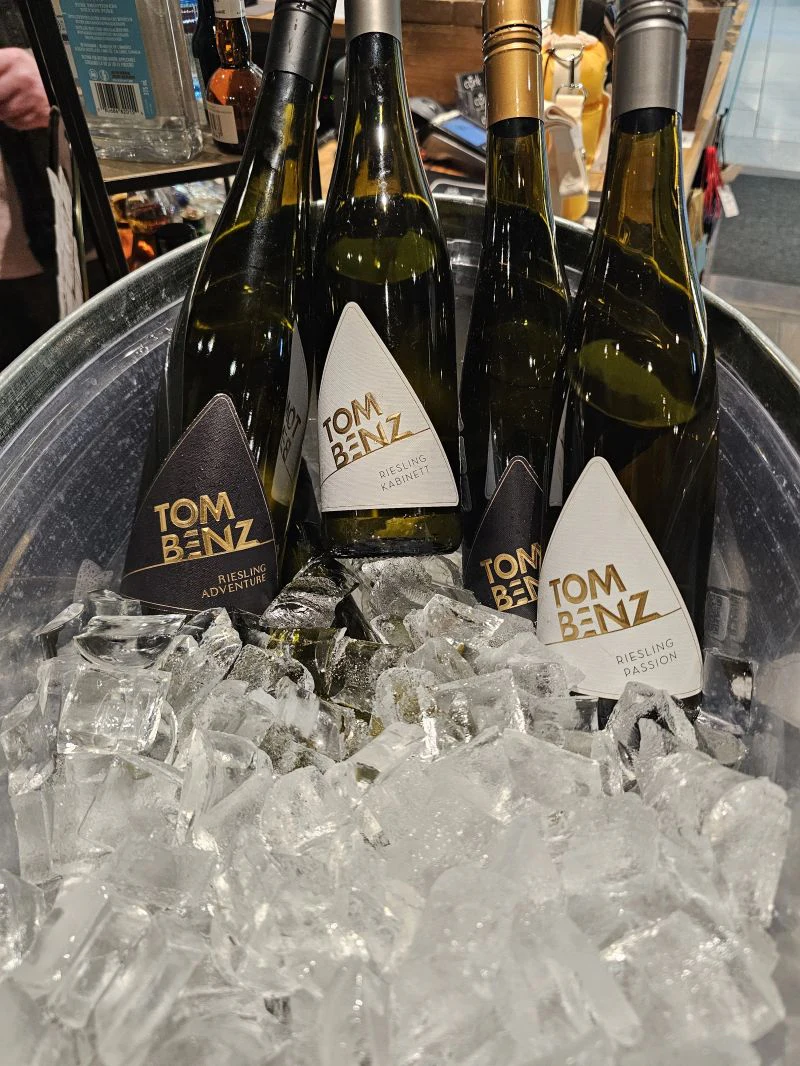
Last weekend, we hosted a tasting of Tom Benz with one of our retail partners.
What made the tasting particularly interesting was that every wine found its own supporters. Same producer, same grape variety, yet the differences in vineyard, ripeness and winemaking resulted in four very different expressions of Riesling.
So rather than simply recording tasting notes, it is worth starting with Minheim itself — and looking at how Tom's vineyards and winemaking choices shape the wines in the glass.
Minheim: an “Island of Sun” on the Mosel
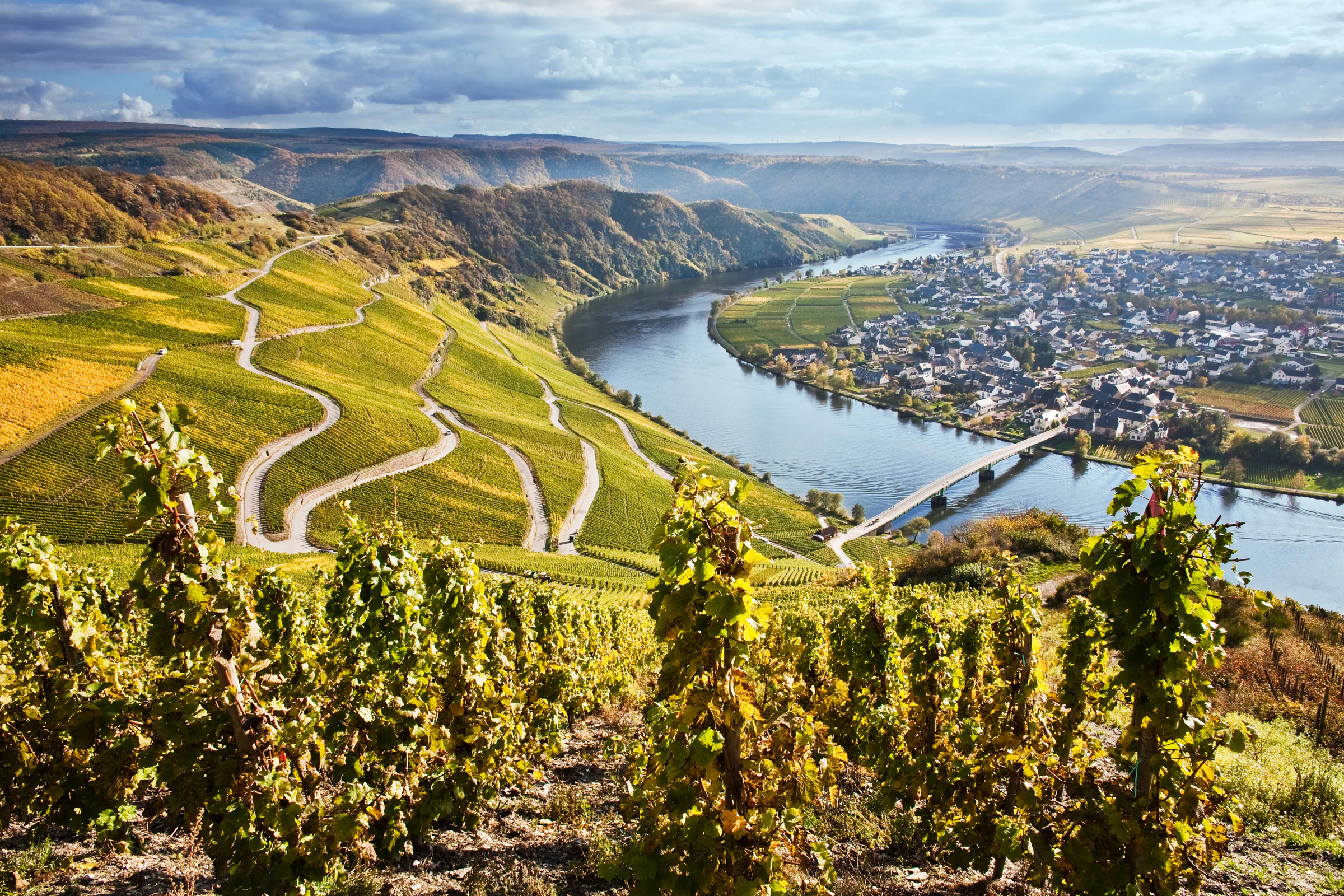
Tom Benz is based in Minheim, a village surrounded by the Mosel River on three sides and locally referred to as an “Island of Sun” (strictly speaking, it is more of a “Peninsula of Sun,” but “Island of Sun” is what the locals call it).
The area is warmer than some neighbouring villages, with predominantly south-facing vineyards benefiting both from direct sunlight and its reflection from the river. These conditions help the grapes achieve good levels of ripeness.
That matters when trying to understand Tom's wines.
Our first impression of his dry Rieslings was quite different from the lean, highly linear style often associated with the Mosel. His wines tend to show more spice, minerality and a rounder texture.
Part of that comes from his approach in the cellar.
A third-generation winemaker, Tom chose to step away from the family estate and develop his own ideas. He started his project in his grandfather's garage and has since grown to around seven hectares of vineyards.
Most of his Rieslings are dry. Depending on the wine, he also allows partial malolactic fermentation to soften sharper acidity while avoiding buttery character. Wild fermentation, extended lees ageing and separate treatment of different vineyard sites are also important parts of his approach.
Tom likes to experiment, but the experimentation is not simply about making something unusual. It is about finding the right expression for each site.
The four wines we tasted offered a good example.
Passion Dry 2024 | The most approachable side
Passion comes from younger vines of around 10–15 years old, mainly from the gentler slopes of Minheimer Rosenberg, where gravel and clay dominate the soils.
The grapes were harvested in October 2024, followed by almost 11 months of lees ageing, until September 2025. Part of the wine underwent malolactic fermentation to soften the acidity.
The wine shows white and yellow fruit, minerality, herbs and a touch of spice.
It is the most immediately approachable of the four Rieslings: bright, energetic and easy to enjoy. It works naturally with cold seafood, salads or simply a few snacks.
Adventure Dry 2023 | Three vineyards in one wine
Adventure was a personal favourite and also one of the most popular wines at the tasting.
It is a blend of three vineyard sites: Gunterslay, Burglay and Kapellchen.
The grapes receive around six hours of skin contact before wild fermentation, while the portion from Gunterslay spends nine months in 500-litre oak barrels.
Each vineyard brings something different to the blend.
Gunterslay is a steep south to southwest-facing (S–SW) site, with a gradient of around 80% and predominantly slate soils. Yields are only around 30 hl/ha. Additional sunlight reflected from the bend of the river contributes to high levels of ripeness, and this is also the lowest-acid site of the three.
Burglay faces southeast, with predominantly gravel and slate soils, contributing minerality.
Kapellchen, facing south and southeast on clay soils, provides acidity and yellow-fruit character.
Together, the three sites create a more multidimensional Riesling, combining ripe fruit, spice, minerality and freshness.
For us, Adventure is also one of the clearest expressions of Tom's personality as a winemaker: open-minded, energetic and never particularly interested in following tradition simply for the sake of it.
Art of Slate Gunterslay Dry 2023 | One site in focus
If Adventure is about bringing three terroirs together, Art of Slate Gunterslay takes one of them and puts it completely in focus.
Gunterslay faces south to southwest (S–SW) and is planted on 100% grey slate. According to Tom, surface temperatures here can reach around 60°C during summer.
The slate absorbs heat during the day and gradually releases it later. Combined with cooler mornings and evenings, this allows the grapes to develop slowly, resulting in smaller, more concentrated berries, with yields of only around 30 hl/ha.
The wine receives around six hours of skin contact, followed by wild fermentation and nine months in used 500-litre barrels.
White peach, flowers and minerality are immediately apparent. The wine is not heavy, but refined and structured, with relatively low acidity compared with the other wines, plenty of complexity and a long finish.
It also has enough character to work beyond classic seafood pairings — something like a gently spiced chicken curry can work surprisingly well.
There is another curious side to Gunterslay: Tom also grows Cabernet Sauvignon here. He once brought the wine to a blind tasting in London, where several tasters apparently placed it in Tuscany. A Mosel Cabernet is certainly something we would like to taste next.
Kabinett 2024 | More than sweetness
We finished with Kabinett 2024.
It also comes from vines around 10–15 years old, but this time in an off-dry expression.
Slow wild fermentation brings natural spiciness and additional complexity, making it more than a simple play between sweetness and acidity.
Interestingly, it was the favourite of several guests who do not drink wine very often.
It is also particularly comfortable at an Asian table: Thai and Vietnamese dishes, mildly spicy food and even dim sum all make natural partners.
More than one expression of Mosel Riesling
In an earlier conversation with Tom, we discussed wild fermentation and ageing potential.
Tom sees wild fermentation as one of the elements that can contribute to a wine's ability to evolve. In his view, the slower fermentation process and the wine's subsequent interaction with the lees can contribute additional structure and give the wine more room to develop with time.
That conversation also says something about the way Tom approaches wine.
His wines are not designed to reproduce a single traditional model of Mosel Riesling. From vineyard management to partial malolactic fermentation, wild fermentation, extended lees ageing and the way different sites are blended or isolated, there is a clear sense of curiosity behind the decisions.
But ultimately, what matters is what ends up in the glass.
The brightness of Passion, the layers of Adventure, the precision and minerality of Gunterslay, and the spicy, easy charm of Kabinett all come from the same winemaker without being forced into the same style.
Perhaps that is one of the most exciting things about a new generation in the Mosel: respecting the land without feeling restricted by how it has always been expressed.
Bottled for the free-spirited.
Originally written in Chinese. English translation assisted by AI.